

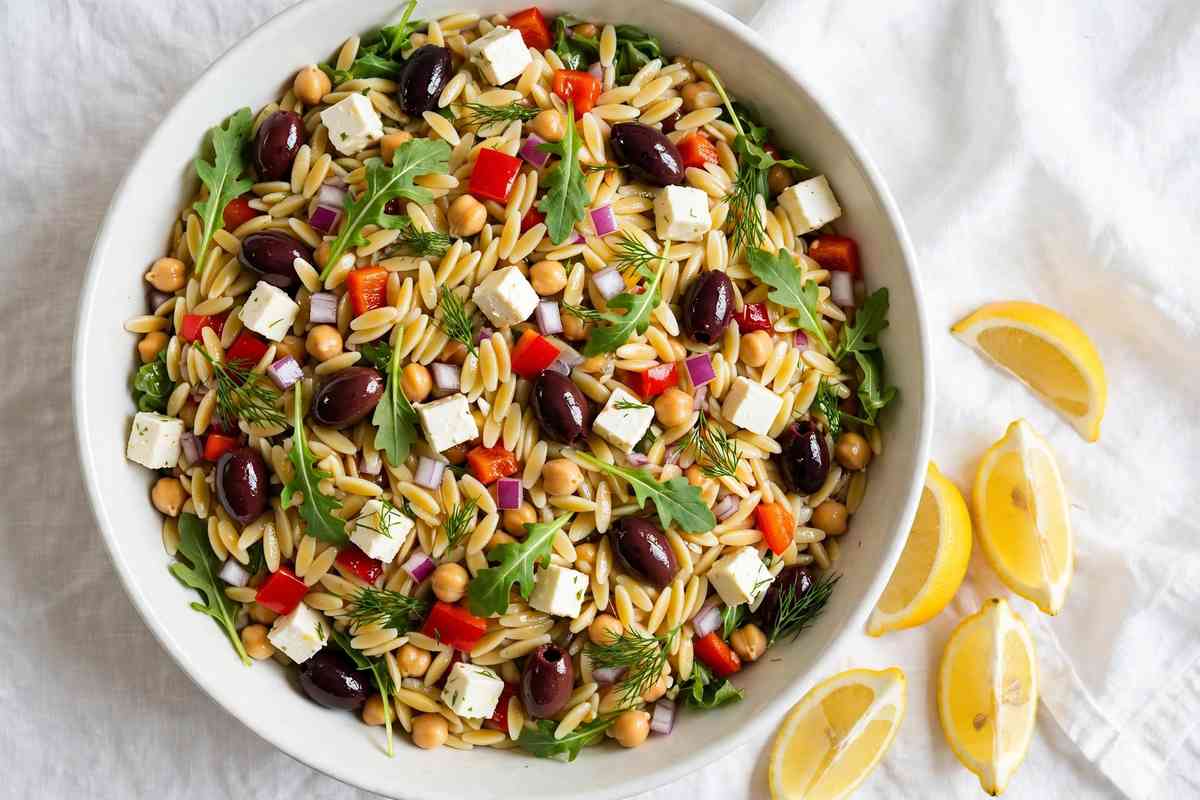
Ina Garten’s Greek orzo salad turns 1 cup of dry orzo into a bowl for six, with a lemon and olive oil dressing that goes on while the pasta is still warm.
There is no vinegar in the dressing. Lemon does the sharpening. Olive oil carries the salt and pepper, and the warm orzo drinks both up before the vegetables arrive.
Dress the pasta cold and the oil slides to the bottom of your bowl, so the warm pour is the step that decides the result. Don’t skip it.
What Goes Into Ina Garten’s Greek Orzo Salad
Six servings come out of one batch, and you’ll need 1 cup of orzo, a half cup each of olive oil, diced red onion, diced red bell pepper and kalamata olives, plus a quarter cup of fresh lemon juice.
- Servings: six, as a side or a light lunch
- Orzo: 1 cup dry, roughly 8 ounces
- Olive oil: 1/2 cup, good enough to eat raw
- Lemon juice: 1/4 cup fresh, plus a wedge for serving
- Feta: 4 ounces, cut into 1/2-inch dice, not crumbled
- Chickpeas: 1 cup canned, rinsed and drained
- Red onion and bell pepper: 1/2 cup of each, diced to 1/4 inch
- Kalamata olives: 1/2 cup, pitted and halved lengthwise
- Capers and dill: 3 tablespoons of each, dill minced
- Arugula: 2 cups baby leaves, added at the end
Garten credits Round Swamp Farm, a third-generation family farm stand in East Hampton, for the idea. “This recipe was inspired by one of their salads,” she writes, naming orzo, olives, feta, lemon and dill as the Greek ingredients she kept.
Business Insider cooked it and reprinted the quantities above. The chickpeas are what push a side dish toward a full lunch!
Greek here describes the flavor set, not a village salad. There’s no lettuce, no cucumber and no vinegar in it.
The feta is diced, not crumbled, and the cut matters. A half-inch cube keeps its shape when you fold the salad. It also gives a salty burst in one bite, which a crumble cannot do. I’m picky about the block in brine, because the pre-crumbled tub is drier and breaks down faster. Buy the block when your store has one, and cut it cold so the cubes stay square.
Crumble the cheese instead and it disappears into the dressing, which turns the bowl cloudy and loses the point of the dice.
Ditalini or small shells work if orzo is missing, though the grains catch the dressing differently.
Dried dill can’t match fresh, though at about a third of the volume it gets close, and chopped parsley covers the gap when neither is around. For the same pasta-salad idea with a sweeter dressing, the Mo Bettahs mac salad runs on a different base entirely.
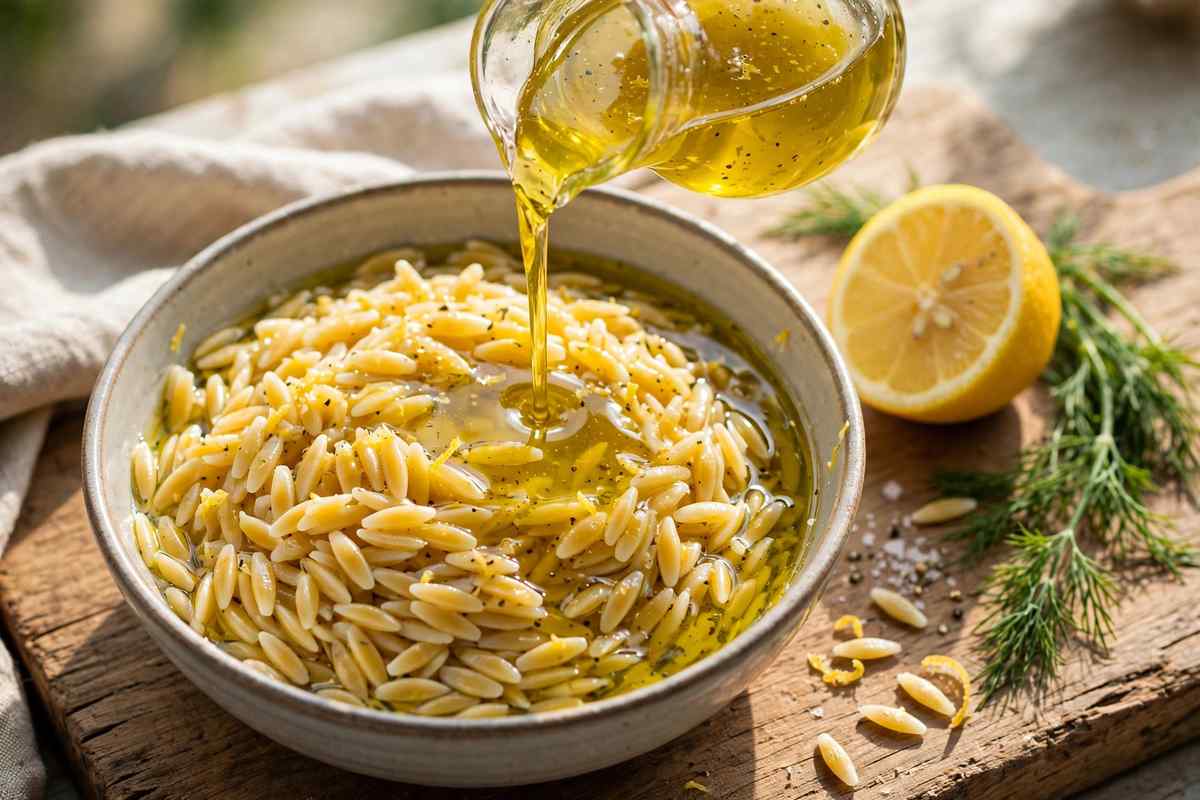
The Ina Garten Greek Orzo Salad Dressing, Two to One
The dressing is 1/2 cup olive oil, 1/4 cup fresh lemon juice, 2 teaspoons salt and 1 teaspoon black pepper. Whisk them in a bowl and you have two parts oil to one part lemon by volume.
Garten pours it over the drained orzo while the pasta is still warm, then stirs and lets the grains take it in. Most vinaigrettes lean on vinegar for the bite. This one leans on lemon alone.
Cold orzo sheds the oil instead. Your salad turns glossy on top and dry underneath. Two parts oil, one part lemon, and the dressing is done!
Her Herbed Orzo with Feta on Food Network uses the same two liquids at one to one, a half cup of each. Doubling the oil is what turns a sharp dressing into one that coats every grain.
Want the vinegar bite of a deli case salad? Add a tablespoon of red wine vinegar and taste. The bowl then reads as a different dish.
This copycat Nish Nosh dressing goes the opposite direction, and it would bury the dill and the lemon if you swapped it in here.
Keep the Greek salad thin and sharp, and let the creamy dressings do their work on a different bowl.
Cooking the Orzo and Building the Bowl
Six cups of water and one tablespoon of salt get the orzo going, and eight to ten minutes at a simmer finishes it. Everything else is knife work you do while the pot heats.
- Bring 6 cups of water to a boil in a large saucepan, then add 1 tablespoon of salt.
- Add 1 cup of orzo, return the water to a boil, lower the heat and simmer 8 to 10 minutes, until the grains are al dente.
- While it cooks, dice 1/2 cup red onion and 1/2 cup red bell pepper, halve 1/2 cup pitted kalamata olives, drain 3 tablespoons of capers, rinse 1 cup of chickpeas and cut 4 ounces of feta into 1/2-inch cubes.
- Whisk 1/2 cup olive oil with 1/4 cup lemon juice, 2 teaspoons salt and 1 teaspoon pepper.
- Drain the orzo and tip it into a large bowl, then pour the dressing over it while hot and stir.
- Add the onion, bell pepper and chickpeas, followed by the dill, olives, capers and feta. Fold with two spoons instead of stirring hard, so the feta keeps its edges.
- Fold in 2 cups of baby arugula just before serving, squeeze over a little lemon and taste for salt.
No special equipment is needed beyond a large saucepan, a whisk and two spoons. A colander with small holes matters more than it sounds. Orzo slips through a wide one and ends up in your sink!
How do you know the grain is ready? Bite one at the 8-minute mark. Al dente orzo gives slightly under the tooth with no chalky core, and it should look a shade paler than it did in the box.
The orzo keeps cooking after it leaves the pot, so pull it while there’s still a little bite at the center. You don’t need a timer, but you do need to start tasting at 8 minutes.
The feta, capers and olives arrive already salty, so the 2 teaspoons in the dressing can be enough on its own.
Taste at the end, not before!
If the grain collapses when you press it against the roof of your mouth, it went too far and the salad turns pasty.
Should You Rinse Orzo for This Salad?
No, and the warmth is the point: the grains absorb the vinaigrette instead of letting it pool in the bottom of your bowl. Garten doesn’t rinse hers either.
What does rinsing actually do? It cools pasta fast, and it washes the surface starch away. That’s exactly what you want for a salad that sits in a cooler for hours.
Neither helps here, because the dressing goes on within a minute of draining and the heat is doing the work.
There’s one case for the tap. If the salad is headed for a hot afternoon table and you want it properly cold, rinse it briefly under cold water and drain it hard.
Then add an extra tablespoon or two of olive oil with a squeeze of lemon at serving. It’ll taste a little brighter. It will also taste a little less knit together, which is a fair trade on a hot day.
Make It Ahead, Arugula Last
Everything but the arugula can be made the day before: cover the dressed salad, keep it cold, and stir the greens in minutes before you eat.
Garten gives that instruction herself. It’s the make-ahead rule that matters most. Wet leaves won’t hold in a dressed salad and go limp and slick overnight.
The orzo, olives, feta and chickpeas hold for a day, and a fresh pinch of dill on the second day brings the herb back.
My dill comes from a pot by the back door in summer and from the store in January. Three tablespoons is about one good handful. I strip the stems before I chop, which takes a minute and keeps the texture loose.
The same herb does heavier work in a simpler egg salad, where it has nothing to hide behind.
If you’re feeding a crowd, double everything and dress the orzo in two bowls. One big bowl takes longer to fold, and the feta breaks up. The bottom half also sits in oil while the top half waits.
Two bowls keep the ratio the same as a single batch, which is what makes the recipe work in the first place.
Serving is loose by design. It sits beside grilled chicken or lamb chops. It also carries a lunch on its own with a piece of bread.
Leftovers keep a day in the refrigerator. After that the arugula gives up and the orzo softens, and a squeeze of lemon before the second serving brings it back most of the way.