

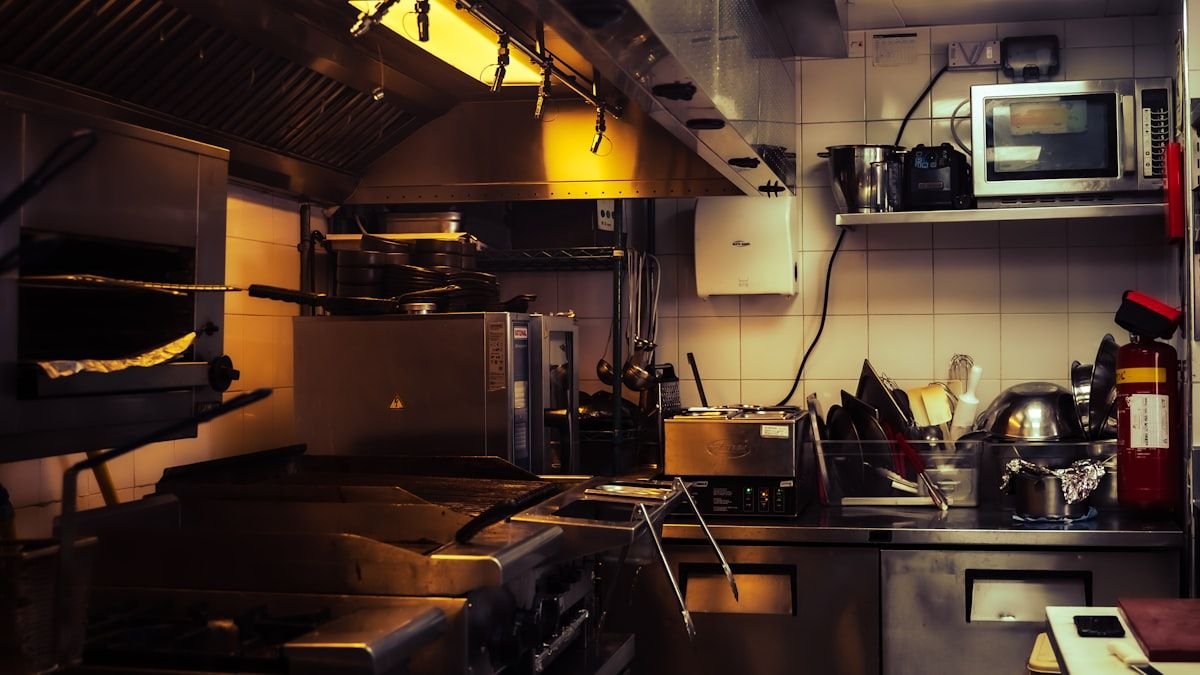
A commercial kitchen equipment checklist covers seven stations: cooking, ventilation, refrigeration, prep, warewashing, storage, and safety. Every restaurant needs something from each; the menu decides how much.
The lists below are written to be printed and walked through a space. Two things most equipment lists skip are added here: the certification rule the health inspector will actually check, and a new-versus-used rule that keeps a first build-out under budget without buying a compressor that dies in month four.
The one requirement inspectors check first
Commercial food equipment must be built for commercial use, and in most U.S. jurisdictions that means certified to an ANSI-accredited sanitation standard, with NSF the mark you will see stamped on nearly everything that passes. The FDA Food Code, which state and county codes are modeled on, requires food-contact equipment to be smooth, nonabsorbent, corrosion-resistant, and cleanable, and treats certification by an ANSI-accredited program as the way to prove it. A residential range or a home fridge fails on the spot, however good it looks.
Ventilation follows a separate rulebook. Anything producing grease-laden vapor (fryers, griddles, charbroilers, ranges) goes under a Type I hood with a fire-suppression system built to NFPA 96; ovens and dishwashers that only produce heat and steam can sit under a Type II hood. Get the hood classification wrong and the fire marshal, not the health inspector, is the one who sends you home. Budget the hood before the range it will cover; it is routinely the most expensive single line in a small kitchen.
Cooking line
Buy the cooking line off the menu, not off a template. A taqueria needs a flat-top and a fryer; a pizzeria needs a deck oven and almost none of the rest.
- Range (gas or electric), 4 to 10 burners, often with a base oven
- Convection oven, the workhorse for anything baked, roasted, or held
- Deep fryer, one or two vats depending on volume
- Griddle / flat-top, for breakfast, burgers, and anything smashed
- Charbroiler, if the menu sells grill marks
- Salamander or cheese melter for finishing
- Combi oven, expensive, replaces three other pieces in a tight kitchen
- Steam table / hot-holding wells for the line
- Microwave, commercial-rated, for reheats
- Specialty units where the concept demands: pizza deck oven, wok range, rotisserie, smoker, plancha
Ventilation and fire safety
- Type I hood over grease-producing equipment, with grease filters
- Type II hood over heat- and steam-only equipment
- Automatic fire-suppression system in the Type I hood, inspected on schedule
- Makeup air unit so the exhaust does not fight your HVAC
- Class K fire extinguisher for grease fires, plus ABC units elsewhere
Refrigeration and freezing
Refrigeration is where undersizing hurts most, because a full walk-in cannot be fixed with a bigger order. One trade rule of thumb ties cold storage to sales volume: roughly a cubic foot of refrigeration for every $75 to $100 of daily sales, which puts a $2,000-a-day operation at 20 to 27 cubic feet of cold space before freezers.
- Walk-in cooler, and often a walk-in freezer beside it
- Reach-in refrigerator(s), one to three doors, near the line
- Reach-in freezer
- Refrigerated prep table (sandwich or pizza style) with pan wells
- Undercounter refrigeration beneath the line
- Ice machine sized to seats plus bar
- Blast chiller, optional, for volume batch cooking and food-safety cooling logs
Prep station
- Stainless prep tables, ideally with undershelves
- Cutting boards, color-coded by protein
- Commercial food processor
- Planetary mixer, 20 quarts and up for anything baked
- Immersion blender and a bar or high-speed blender
- Meat slicer, if the menu has deli or charcuterie
- Digital scale and portion scales
- Can opener, table-mounted
- Knives, sheet pans, hotel pans, mixing bowls in quantities you will underestimate
Warewashing
The three-compartment sink is not optional and it is not the dish machine’s job. Health codes require it for wash, rinse, and sanitize even when a machine is present, plus separate handwashing sinks in every prep and dish area and a mop sink no one wants to think about until the inspector asks.
- Three-compartment sink with drainboards
- Commercial dishwasher, undercounter, door-type, or conveyor by volume
- Handwashing sinks, one per work area, with soap and towel dispensers
- Mop sink
- Grease trap / interceptor, sized by the plumbing code
- Dish racks, drying racks, chemical dispensers
Storage and shelving
- Dry storage shelving, wire or polymer, six inches off the floor
- Ingredient bins for flour, sugar, rice
- Food storage containers with lids and date labels
- Utility carts and dunnage racks
- Chemical storage physically separated from food
Safety and sanitation
- Thermometers: probe, fridge, and hot-holding
- Sanitizer test strips and labeled sanitizer buckets
- First-aid kit with burn supplies
- Anti-fatigue and non-slip mats
- Wet-floor signs, cut-resistant gloves
- Handwashing signage and an allergen board
What a full build-out costs
Equipment for a small quick-service kitchen commonly lands in the $40,000 to $80,000 range, casual dining $60,000 to $120,000, and fine dining $100,000 to $200,000 or more, with a food truck fit-out at $25,000 to $50,000. Those bands come from GoFoodservice’s build-out guide and match what WebstaurantStore’s equipment list implies once you price its categories. Older industry guides quoting “upwards of $250,000” for a fully outfitted kitchen are describing the top of that fine-dining band.
| Station | Small kitchen | Full-service kitchen |
|---|---|---|
| Cooking line | $15,000 – $25,000 | $25,000 – $45,000 |
| Refrigeration | $8,000 – $15,000 | $15,000 – $35,000 |
| Warewashing | $5,000 – $10,000 | $10,000 – $25,000 |
| Storage | $3,000 – $6,000 | $6,000 – $12,000 |
| Safety and sanitation | $2,000 – $4,000 | $4,000 – $8,000 |
Hood and ventilation sit outside that table on purpose: installed cost swings so widely with ductwork and local fire code that any national number would mislead. Get two local quotes early.
Where to buy used, and where not to
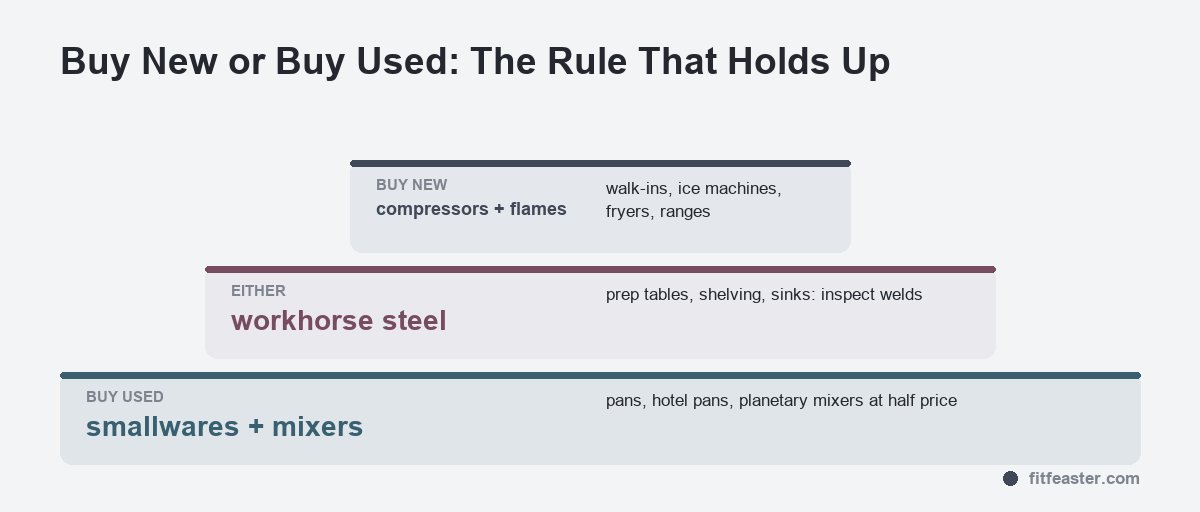
The savings on used equipment are real, often half of new, and so is the failure risk, and the two do not land on the same items. Anything with a compressor or an open flame (walk-ins, reach-ins, ice machines, fryers, ranges) carries the highest repair bills and the most inspection scrutiny, so buy those new with a warranty when the budget allows. Stainless workhorses like prep tables, sinks, and shelving are close to indestructible; inspect the welds and buy whichever is cheaper. Smallwares and planetary mixers are the safest used purchases in the trade.
Two more traps. Used equipment must still carry its certification plate; a sanded-off NSF mark is a red flag, not a bargain. And confirm the utility hookup before you pay: a used range plumbed for natural gas will not run on a propane line without a conversion kit, and 3-phase electric equipment is dead weight in a building wired for single-phase.
Small operators unsure whether they have outgrown a home setup should read when a home kitchen is no longer enough before pricing any of this; and anyone starting a truck or catering business rather than a restaurant may need a commissary kitchen instead of half this list.
FAQ
What is a requirement for equipment to be used in a commercial kitchen?
Food-contact equipment must be commercial-grade and, in most jurisdictions, certified to an ANSI-accredited sanitation standard such as NSF, meaning smooth, nonabsorbent, corrosion-resistant, and cleanable surfaces. Grease-producing appliances also require a Type I hood with fire suppression under NFPA 96.
What are 10 essential large pieces of equipment in a commercial kitchen?
Range, convection oven, deep fryer, griddle, Type I hood with suppression, walk-in cooler, reach-in refrigerator, refrigerated prep table, commercial dishwasher, and a three-compartment sink cover nearly every concept; an ice machine is the usual eleventh.
What does a small commercial kitchen checklist leave out?
Drop the walk-in for a second reach-in, skip the combi oven and charbroiler unless the menu demands them, and choose an undercounter dishwasher over a door-type. Keep every item in the safety, warewashing, and ventilation sections; those do not scale down with square footage.
How much does commercial kitchen equipment cost?
Roughly $40,000 to $80,000 for a small quick-service kitchen, $60,000 to $120,000 for casual dining, and $100,000 to $200,000 or more for fine dining, before hood and ventilation installation. Buying steel and smallwares used typically trims 20 to 30 percent off the total.