

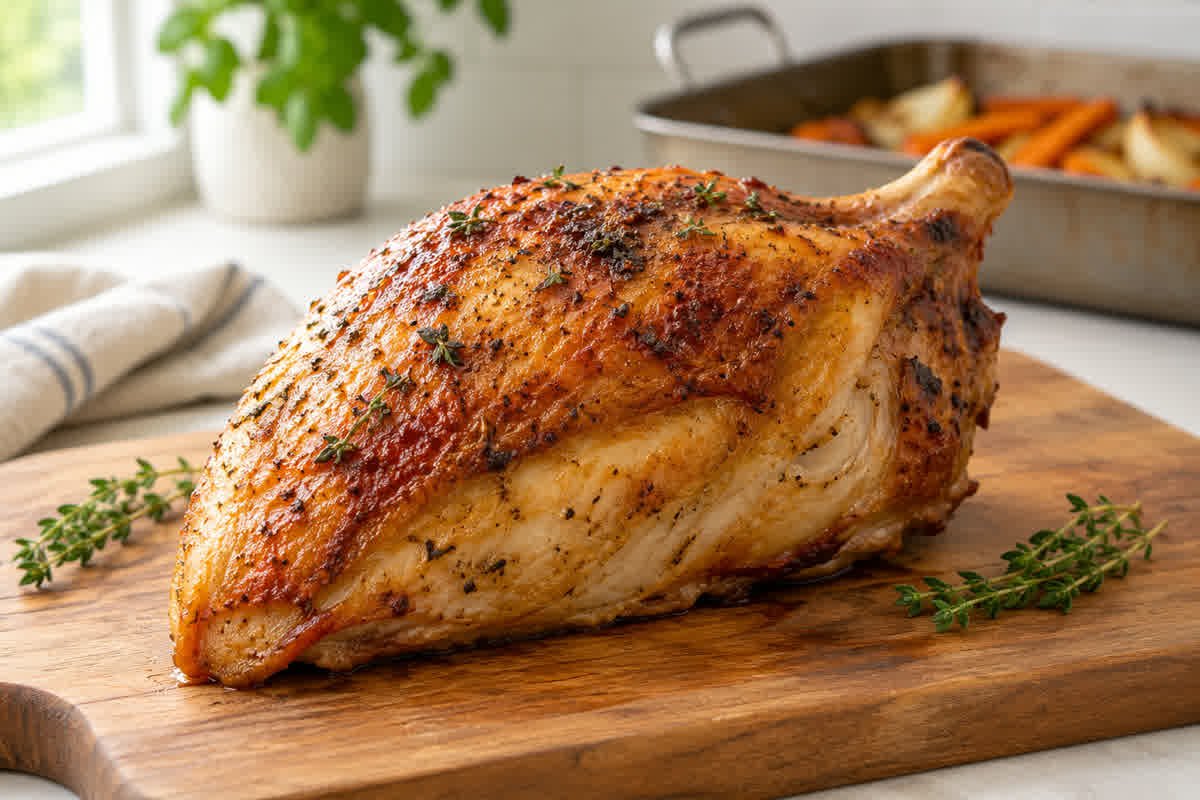
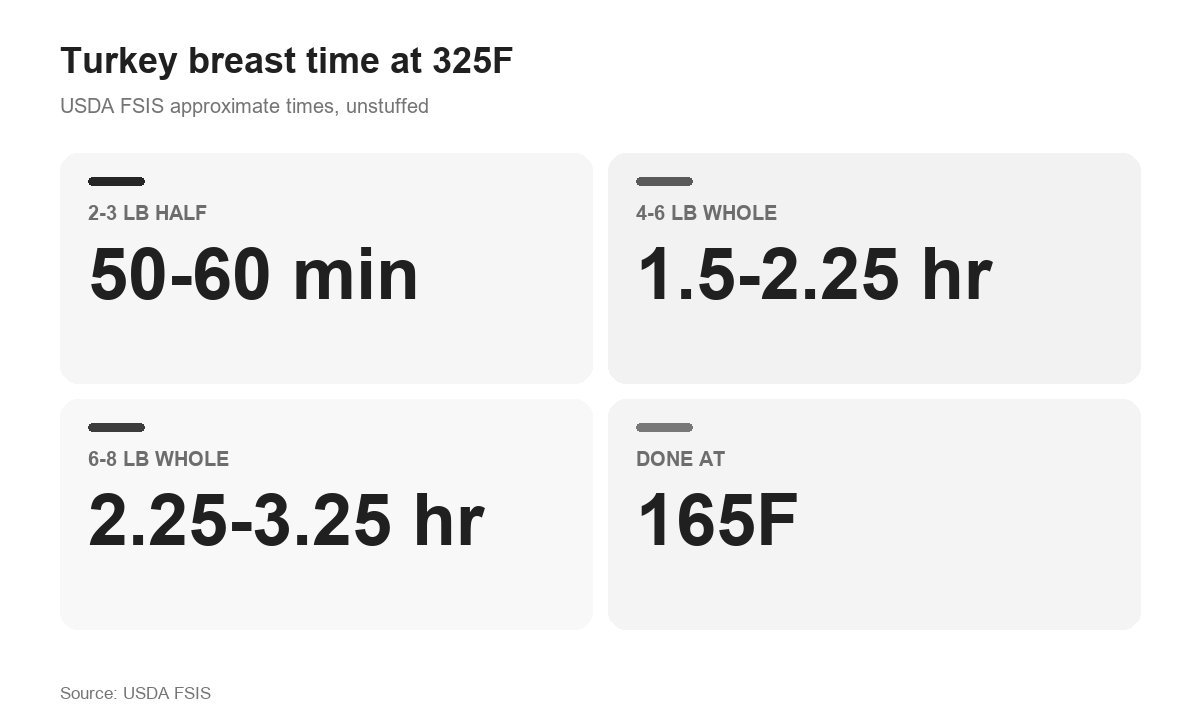
The turkey breast recipe that works for most small tables is plain. Roast it at 325°F until a food thermometer reads 165°F in the thickest part, then let it stand 20 minutes. Timing depends on weight. A half breast of 2 to 3 pounds takes about 50 to 60 minutes, while a whole bone-in breast of 4 to 6 pounds takes about 1½ to 2¼ hours, and a breast up to 8 pounds runs about 2¼ to 3¼ hours. Those are USDA’s times, and they’re approximate, so the thermometer makes the final call.
Why a breast and not the whole bird? Most of us aren’t feeding twelve. A whole turkey means a 20-pound bird for a table of four, and then a week of turkey sandwiches. One home cook on Reddit described a bone-in, skin-on breast like this:
“They had gotten one a few years back that was the uncooked breasts, bone in, skin on, and it came out great and was just the right amount.”
– r/Cooking, November 2025
“Just the right amount” is the whole pitch. The catch is that a breast is lean, and lean meat goes from juicy to dry in a few minutes. So everything below is built on weight and temperature, not a clever rub.
How big a turkey breast to buy
USDA’s Food Safety and Inspection Service (FSIS) says to allow 1 pound of turkey per person. That rule is written for whole birds, bones included. I’ve applied it to a bone-in breast here as simple arithmetic, so treat the pairing as a starting point and not a USDA table. If you want sandwiches the next day, round up.
| Eating | Buy about | USDA time band | Time at 325°F |
|---|---|---|---|
| 2 people | 2 lb | Half breast, 2 to 3 lb | 50 to 60 minutes |
| 3 people | 3 lb | Half breast, 2 to 3 lb | 50 to 60 minutes |
| 4 people | 4 lb | Whole breast, 4 to 6 lb | 1½ to 2¼ hours |
| 6 people | 6 lb | Whole breast, 4 to 6 lb | 1½ to 2¼ hours |
| 8 people | 8 lb | Whole breast, 6 to 8 lb | 2¼ to 3¼ hours |
The times are for an unstuffed breast. USDA says stuffing adds time, roughly 30 minutes, so baking stuffing in its own dish keeps the math simple. For a crowd on a holiday, the Thanksgiving turkey calculator takes your guest count and a breast weight and works out the plan, thawing included.
A simple turkey breast recipe for the oven
This is the main method, and it has few steps on purpose. You need a roasting pan with a rack, a thermometer, and about ten minutes of hands-on time.
- Thaw a frozen breast fully in the fridge before you start. A cold center is how you end up with a dry outside and an underdone middle.
- Heat the oven to 325°F. USDA says no lower than that.
- Pat the skin dry with paper towels. Rub it with butter or oil, then salt and pepper. Garlic, thyme or sage are nice, and a spoonful of poultry seasoning stands in if you don’t have fresh herbs.
- Set the breast skin side up on a rack in the pan. A few carrots and onions underneath work as a rack if you don’t own one.
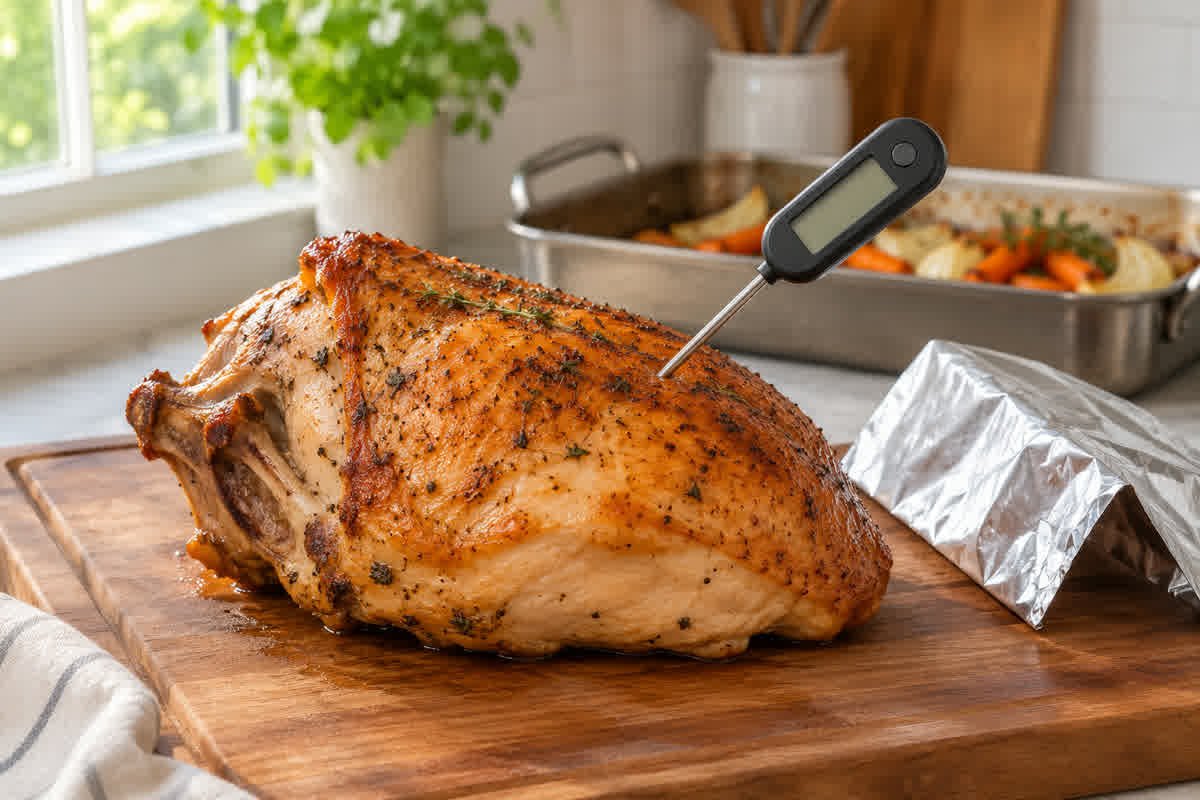
- Start checking about 20 minutes before the low end of your time band. Slide the thermometer into the thickest part, away from the bone.
- Pull it at 165°F. Tent it loosely with foil and let it stand 20 minutes before you carve.
Two flavor variations
Plain salt and butter is a fine default, and these two are easy swaps. Both are suggestions, not tested ratios, so season to taste.
- Garlic-herb butter. Mix softened butter with minced garlic and chopped thyme or sage, then rub it under and over the skin before roasting. Dried herbs work if that’s what’s in the cupboard.
- Honey-mustard glaze. Stir honey into Dijon mustard and brush it on during the last stretch of roasting, not at the start. Sugar browns quickly, so a late coat keeps the skin from scorching while the thermometer is still climbing.
If you want it brined first, a brine helps lean meat hold moisture, and there’s a full comparison in how to brine a turkey. One sentence is all it gets here.
165°F, and why I don’t pull it early
Some recipes pull a breast at 160°F and count on carryover heat to finish the job. USDA’s number for poultry is 165°F, measured with a food thermometer in the thickest part of the breast. Color and the clock don’t count. I stick with 165°F, and the 20-minute stand is what keeps it moist. The juices settle while it sits, so the slices stay tender even at the safe temperature.
Where should the probe go? In from the thick end, aimed at the center, with the tip off the bone. A probe touching bone reads high and fools you into pulling the breast too soon. When you’re unsure, check two spots and trust the lower number.
Skin that isn’t crisp enough at the end is fixable. Take the foil off for the stand, or give the breast a few minutes under a hot broiler while you watch it. Don’t let that tempt you to leave it in the oven longer, because the thermometer already told you it was done!
Turkey breast in a slow cooker
The slow cooker is my second route, mostly for a small boneless breast that fits the pot. It gives you tender, shreddable meat instead of crisp skin. Add a splash of broth, season the breast, cover it and let it go.
I don’t have a USDA time to quote for slow cookers, so I won’t invent one. Times vary with the machine and the size of the breast. Check the thickest part with a thermometer, and the same 165°F applies. If the breast sits in liquid, probe through the meat itself and not the broth, and lift it out to rest for the 20 minutes before slicing. Start checking earlier than you think you need to.
Boneless, bone-in and the precooked kind
Bone-in, skin-on breast takes longest, but the skin and bones keep the meat juicier. A boneless breast cooks faster. The USDA tables I found cover bone-in breasts by weight, so for boneless I have no sourced time. Use the thermometer, start checking early, and don’t borrow the numbers from the table above. A boneless roast, especially a rolled or netted one, can be thicker in the middle than it looks, so probe the center and the thickest end and go by the lower reading. Doneness is the same 165°F either way.
Then there’s the precooked breast, the deli-style kind that’s already cooked. You’re only reheating it. The same Reddit thread had a very practical answer for a cook stuck with one:
“Reheat in the oven in gravy and call it a day. Make some sides. Less work for you.”
– r/Cooking, November 2025 (216 upvotes)
Follow the package for reheating directions. The raw-breast table above doesn’t apply to it.
Leftovers and make-ahead
FSIS says to refrigerate cooked turkey within 2 hours and to use leftovers within 3 to 4 days. Slice the meat off the bone first so it cools faster. I carve extra on purpose, because the next day’s sandwiches are half the reason to cook a breast. When you have a cup or two of diced turkey left, leftover turkey recipes has soup, tetrazzini and pot pie ideas.
For a make-ahead dinner, season the breast the day before and keep it in the fridge. Then all that’s left on the day is the oven and the thermometer. That’s a real help when the rest of the kitchen is busy!
Quick answers
Cooking time. At 325°F, about 50 to 60 minutes for a 2 to 3 pound half breast, and about 1½ to 3¼ hours for a whole bone-in breast up to 8 pounds. USDA calls these times approximate.
Done temperature. 165°F in the thickest part, checked with a food thermometer.
Resting. USDA suggests about 20 minutes before carving.
Stuffing. You don’t need it. Stuffing adds time, and the times above assume the breast is unstuffed.