

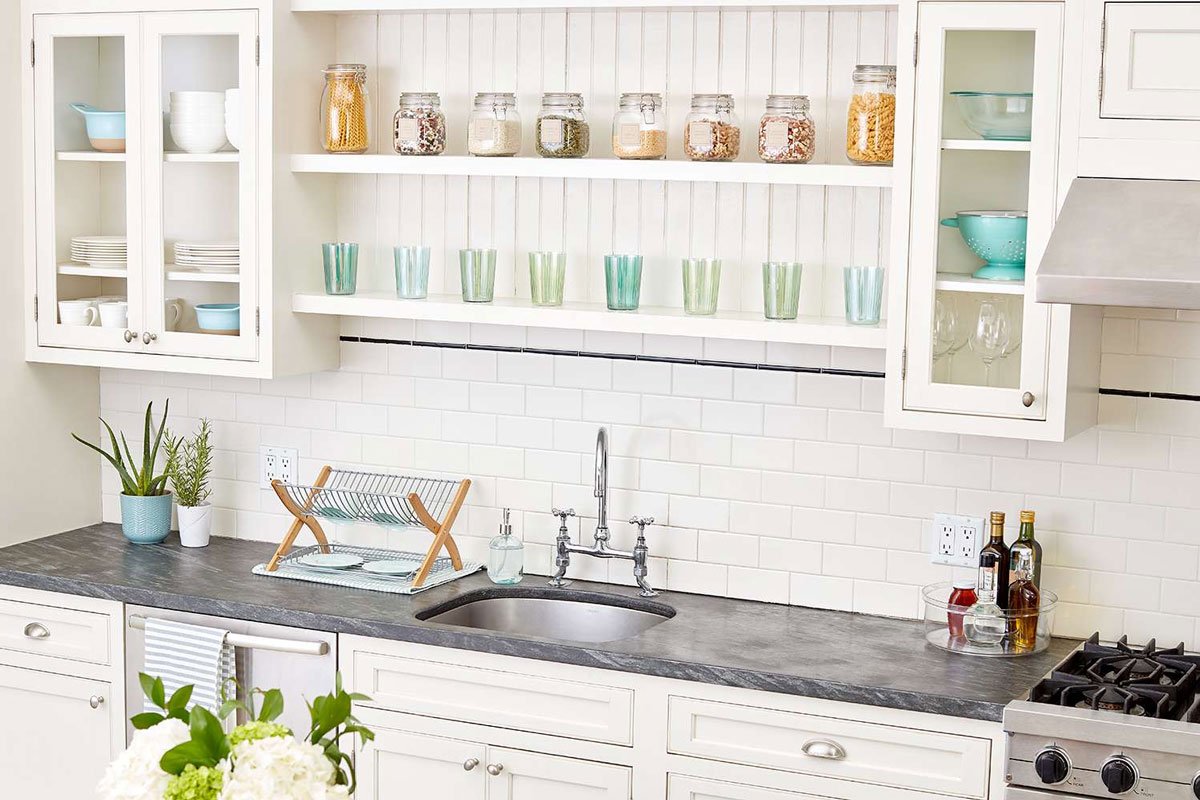
Kitchen cabinets work best when they are organized by frequency, weight, and task zone instead of by whatever shelf happens to be empty. If you are figuring out how to organize cabinets in the kitchen, start by giving everyday dishes, food, cookware, and backup stock each a fixed home so the mess stops spreading every time a cabinet door opens.
Picture the usual breaking point: groceries on the counter, dishwasher half unloaded, two travel mugs in your hand, and no obvious place for either one. Most cabinet disorder starts there, in tiny decisions made when the kitchen is busy, not in some dramatic shortage of storage.
Start by clearing the clutter your cabinets are carrying
When a grocery bag is balanced on one hip and the cabinet in front of you is already full, how to organize cabinets in the kitchen stops feeling theoretical very quickly. The fastest way forward is to remove what never needed cabinet space in the first place, then return only what still earns its spot.
Start with four piles: everyday use, occasional use, backup stock, and elsewhere. “Elsewhere” matters because cabinets often become parking lots for water bottles, unopened mail, duplicate containers, and appliances that would make more sense in a pantry, drawer, closet, or donation box.
What to remove before you organize
- Expired pantry goods, stale spices, and anything you forgot you owned.
- Chipped dishes, warped food containers, and lids that match nothing.
- Single-use gadgets you have not touched in the last year.
- Countertop overflow that landed in a cabinet only because it was nearby.
- Seasonal serving pieces that belong in a higher or farther storage zone.
FoodSafety.gov says the FoodKeeper app was developed by the USDA’s Food Safety and Inspection Service with Cornell University and the Food Marketing Institute to help people understand food storage and keep items fresh longer. That is a useful reminder for cabinet cleanup: backup cans, grains, and snacks should be dated, grouped, and rotated instead of disappearing behind newer purchases.
The clutter usually looks random, but it is often postponed decision-making in disguise. Once the doubles, dead stock, and misfit tools leave, the cabinet suddenly stops asking for miracle organizers.
Build a cabinet map around reach, weight, and workflow
On a rushed weeknight, the cabinet layout either helps dinner happen or turns every small reach into friction. The core rule for organizing kitchen cabinets is simple: keep everyday items between shoulder and knee height, store heavy pieces low, move backups high, and place each category near the task it supports.
The pressure point is timing. A cabinet plan fails when it asks for careful thought at the hungriest part of the day.
Professional organizer Sarah Giller Nelson of Less is More Organizing Services has framed the principle neatly: items should be placed based on frequency of use first, then refined with organizing supplies. That order matters because pretty bins cannot rescue a cabinet that asks you to reach overhead for a Dutch oven or crouch for the mugs you use every morning.
The everyday zone is the cabinet space between your shoulders and knees for items you use most days. The support zone is the nearest cabinet to the dishwasher, prep area, stove, or coffee station where those items are actually handled.
Use a simple reach-zone system
- Eye-level shelves: plates, bowls, glasses, lunch containers, coffee mugs, and everyday pantry staples.
- Waist-level shelves: mixing bowls, colanders, small appliances used weekly, and food prep tools.
- Lower cabinets: pots, pans, Dutch ovens, bulk goods, and heavier appliances.
- Upper shelves: holiday platters, cake stands, backup paper goods, and reserve stock.
- Awkward corners: only items that suit a turntable, pull-out, or deep bin system.
Think about the sequence of dinner on a busy weeknight. If plates live across the room from the dishwasher, spices are hidden above the fridge, and the skillet lid is behind baking pans, the kitchen keeps taxing the same small movements until the whole room feels tiring.
A calmer kitchen is often just a less punishing one. Heavy and awkward items stop fighting your body once the lower cabinets do the hard work they were meant to do.
Use storage helpers only where they solve a specific problem
Kitchen cabinet organizers are worth buying when each one fixes a named frustration such as stacked pans falling over, deep shelves hiding food, or corner cabinets swallowing small items. If you cannot finish the sentence “this will solve…,” leave the organizer on the shelf for now.
Most cabinets need fewer products than people think. They need better restraint, clearer categories, and enough separation that one grabbed item does not bring down three more with it.
The tradeoff shows up fast here. Every organizer that adds one more step to putting something away gets abandoned sooner than people expect.
Best fixes for common cabinet problems
| Problem | Best fix | Why it works |
|---|---|---|
| Deep shelves hide pantry goods | Clear bins with labels on the front edge | You can pull the whole category forward instead of excavating the back row |
| Tall shelves waste vertical space | Shelf risers | They create a second level for mugs, bowls, or cans without stacking dangerously high |
| Baking sheets and cutting boards topple | Vertical dividers | A vertical divider is a narrow slot system for trays, lids, boards, and pans |
| Corner cabinets lose small items | Turntables or pull-out trays | Rotation beats blind reaching in dark corners |
| Lids and wraps create drawer-like clutter | Door-mounted rack or slim bin | Thin items stay upright and visible instead of sliding into a pile |
What not to buy too early
Do not start with decanting containers, matching jars, or elaborate shelf systems before the categories are settled. Those upgrades look efficient, but they often lock bad decisions into place and make future edits slower.
The smartest organizer is usually the one that removes a daily irritation you can name without thinking. When a single skillet no longer brings down four lids, the cabinet starts teaching you what else it actually needs.
Decide what goes in each cabinet before you buy anything else

If you want to know what goes where in kitchen cabinets, assign each cabinet a job before you start arranging the items inside it. A cabinet-by-cabinet plan cuts decision fatigue, speeds up unloads, and prevents categories from drifting across the room over time.
Use the table below as a starting map, then adjust it to your room shape and the way you cook. The goal is not perfection. The goal is making the obvious home for each item so obvious that it stays obvious when the kitchen is busy.
| Cabinet zone | Best items | Avoid storing | Helpful add-on |
|---|---|---|---|
| Near dishwasher | Dinner plates, bowls, glasses, lunch containers | Rarely used serveware and holiday pieces | Shelf riser for mugs or cereal bowls |
| Near prep area | Mixing bowls, measuring tools, cutting boards, oils used daily, salt | Backup cans and unopened bulk goods | Vertical divider for boards and sheet pans |
| Lower cabinets by stove | Pots, pans, skillets, lids, Dutch ovens | Paper goods, snack boxes, and anything crushable | Pan rack or lid divider |
| Upper cabinets | Reserve stock, party platters, seasonal bakeware | Heavy cookware and fragile everyday glassware | Bin for backstock rotation |
| Under-sink or utility-adjacent cabinet | Cleaning products, trash bags, gloves, dish tabs | Food, pet treats, and reusable snack containers | Caddy or bin to separate categories |
Small-kitchen swaps that create space
Small kitchen cabinet organization gets easier when every category has a space limit. Keep one shelf for everyday food storage containers, one bin for snacks, one narrow section for baking supplies, and one upper zone for true backup stock instead of letting every category grow sideways.
If you do not have a pantry, choose one cabinet to function like a mini pantry and protect it from cookware creep. Deep shelves become more useful when you keep the back for unopened stock and the front for items already in rotation.
What should not live in kitchen cabinets
Some items make cabinet life harder even when they technically fit. Over-the-stove cabinets are poor homes for paper goods, cluttered oils, and awkward plastic because heat and hurry are a bad combination, while cleaning products should stay separated from food and snack gear so the category line never gets blurry.
The real luxury in a kitchen is not extra storage. It is opening a door and already knowing where something lands.
Protect the system with a ten-minute weekly reset
The moment cabinets usually slide backward is not during a deep clean. It is on the third tired evening in a row, when unloading feels negotiable and items get parked on the first open shelf.
Organized kitchen cabinets stay organized when small resets happen before drift turns into another full weekend project. A quick weekly pass, plus a monthly check for expired food and duplicate containers, does more for long-term order than any one-time marathon cleanout.
Pick one anchor moment that already happens in your week, such as after groceries come home or right after the dishwasher is empty. Tie the reset to that moment so cabinet upkeep becomes part of the kitchen rhythm instead of a separate chore you keep postponing.
The five-minute unload rule
- Put everyday dishes back in their exact cabinet before handling specialty pieces.
- Return lids with containers immediately so orphan pieces do not start a new pile.
- Pull one item from the back if you add a duplicate to the front.
- Move one misplaced object out of the cabinet every time you notice it.
- Stop stacking “for now” items on the first open shelf.
The monthly cabinet check
Once a month, scan for expired goods, repeat purchases, bent foil boxes, cracked containers, and empty space that has turned into junk space. This is also the moment to ask whether a cabinet still matches your actual cooking habits or whether the kitchen has quietly changed around it.
Cabinets rarely collapse into chaos in one dramatic afternoon. The risk shifts slowly, then all at once, because the easy decisions stop being easy and nobody resets them while the mess is still small.
Frequently asked questions
How do you organize kitchen cabinets in a small kitchen?
Organize small kitchen cabinets by giving each category a strict space limit, storing heavy cookware low, keeping everyday dishes near the dishwasher, and using vertical dividers or bins only where they recover wasted depth. The key is reducing category spread, not cramming more objects into every opening.
What should not be stored in kitchen cabinets?
Kitchen cabinets should not hold expired food, duplicate containers without matching lids, heavy pots on high shelves, or cleaning products mixed with food-related items. Cabinets above the stove also deserve extra caution because hurried access and heat make that zone a poor fit for clutter.
Are labels worth it in kitchen cabinets?
Labels are worth it when a bin or shelf holds one repeated category such as snacks, baking supplies, wraps, or backstock pantry goods. They are less useful when the cabinet layout itself is still unsettled, because labels can make a bad system look finished before it actually works.
How often should kitchen cabinets be reorganized?
Most kitchen cabinets only need a quick weekly reset and a deeper monthly edit, not a full reorganization every few weeks. A full overhaul usually makes sense after a move, a renovation, a big shift in cooking habits, or a long period of accumulated clutter.
Which organizers make the biggest difference first?
Shelf risers, vertical dividers, and clear pull-forward bins usually make the biggest difference first because they solve wasted height, collapsing stacks, and hidden back rows. Start with the cabinet that annoys you most often, because that is where a small fix pays back fastest.
Final thought
Organizing kitchen cabinets is less about buying a matching set of containers and more about assigning fewer, clearer decisions to your busiest moments. Once you know how to organize cabinets in the kitchen in a way that matches your real routine, the room stops asking you to improvise every day.