


Char the corn hard, then sauce it while hot. Do it in that order and the mayonnaise clings to browned kernels and turns glossy; do it the other way and you get corn with dressing sitting on top of it.
Most home versions fail at the same place. The ears go on wet, they never darken past pale gold, and when the sauce hits them it slides straight down into a pink puddle at the edge of the plate. Every Mexican street corn recipe online will tell you the sauce is the heart of the dish. The sauce takes about three minutes and is nearly impossible to ruin.
Getting the corn dark is the part that takes attention.
The Mexican street corn recipe, start to finish
Six shucked ears browned over high heat, then coated in cotija, mayonnaise, Mexican crema, garlic, lime and chile powder while the corn is still steaming. Serves six as a side, three as the centre of a plate.
The sauce ingredients:
- 3/4 cup finely crumbled cotija, about 2 1/2 oz, plus more to finish
- 1/3 cup mayonnaise
- 1/4 cup Mexican crema or sour cream
- 1 medium clove garlic, minced to a paste, about 1 tsp
- 2 tbsp finely chopped cilantro leaves and tender stems
- 1 tsp ancho or guajillo chile powder, plus more for sprinkling
- 1/2 tsp smoked paprika
- Zest of 1 lime, with the lime cut into wedges for serving
And the corn:
- 6 ears fresh corn, husks and silk removed
- 1 tbsp neutral oil such as canola
- 1/2 tsp kosher salt
- Tajín, for sprinkling at the table
- Dry the ears. Roll each one in paper towel and press along the length of the cob until the surface stops feeling slick. This step decides how the rest of the recipe goes.
- Stir the cotija, mayonnaise, crema, garlic, cilantro, chile powder, smoked paprika and lime zest together in a wide bowl, one big enough to roll an ear around in. Leave it on the counter. Cold sauce on hot corn seizes into clumps.
- Rub the dry ears with oil, using your hands so the coating stays thin, and season them with the salt.
- Bring the heat up high. Charcoal spread over half the grate, a gas grill at 450 to 475F, or an oven rack in the top third with the broiler on high.
- Cook the corn until it is tender and blackened in patches on every side. Over hot coals that runs about 8 minutes; on gas, 15 to 20 with a turn every 3 or 4; under a broiler, roast at 425F for 15 minutes first, then broil for 7 to 9, flipping halfway.
- Let each ear sit off the heat for a minute, then roll it through the sauce until it is coated on all sides.
- Finish with more cotija, a dusting of chile powder or Tajín, the rest of the cilantro, and a lime wedge on the plate.
Plan on more corn than feels reasonable. An ear and a half per person is the floor, and two is closer to what people take when the plate is in front of them.
What makes corn char and not steam
Browning starts around 140 to 165C, and water on the surface of a kernel holds that surface at 100C until it boils away. A wet ear spends its first several minutes drying rather than colouring.
The flavour everyone is chasing comes from the Maillard reaction and from sugars caramelising at the tips of the kernels, and both need a dry, hot surface to get going. That is the entire reason a cook who has already husked the corn should still reach for paper towel. Corn straight from the fridge carries condensation. Corn rinsed under the tap carries more.
Texture follows from the same physics. Kernels that brown quickly stay plump because the interior has less time to cook through, so they burst when you bite them, which is the difference between elote and a boiled cob wearing cheese.
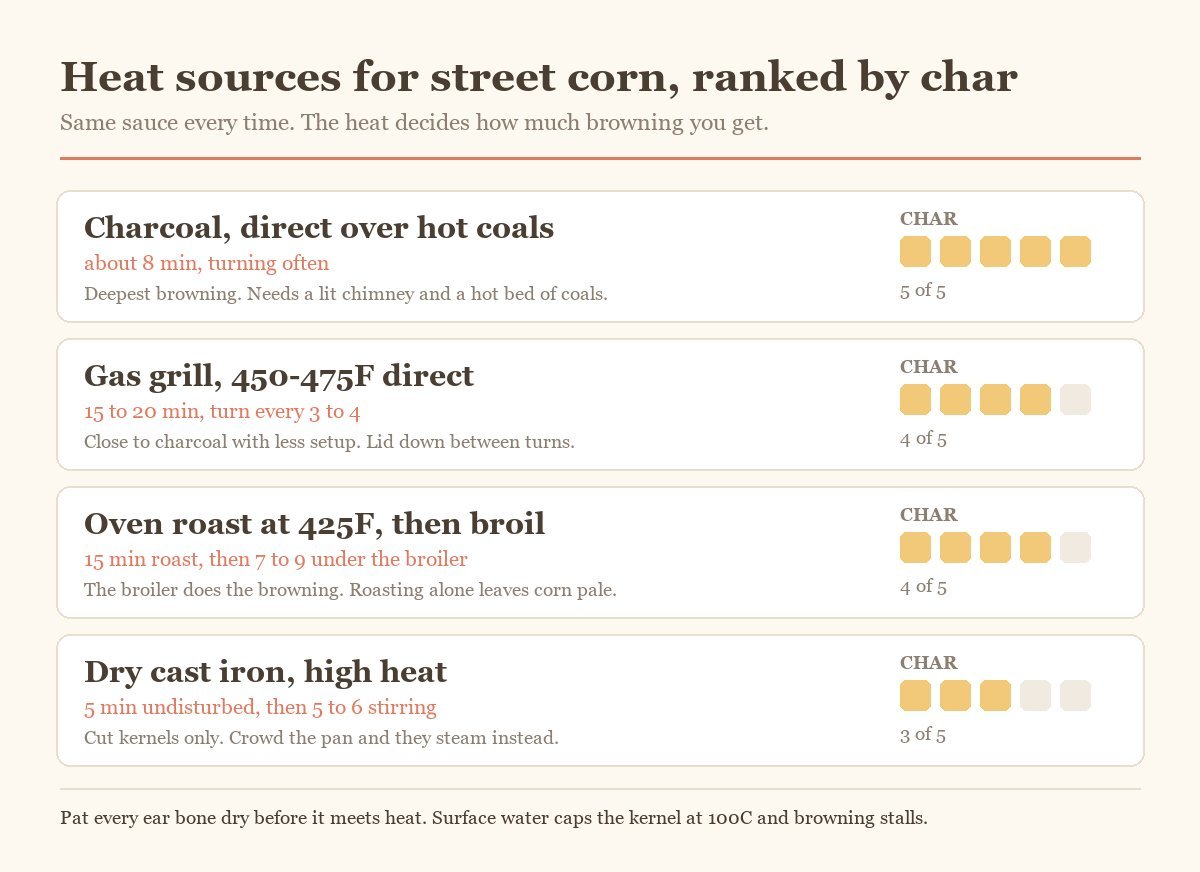
Charcoal wins on browning and loses on setup. A chimney of coals takes 20 minutes to ash over before you can start, and for a weeknight side dish that is a lot of ceremony. The broiler route gets you most of the way there with an oven you were going to preheat anyway, and it works in February. If you are chasing the best version of this dish, it is fresh yellow corn over charcoal, and the broiler is the one you will repeat on a Tuesday.
The dry skillet sits lowest on that chart because it only works with kernels cut off the cob. Whole ears in a pan touch the metal along a thin stripe and brown in stripes to match. Cut kernels spread out and take colour across their flat faces, which is a different and perfectly good dish.
Cooks on r/food argue for the opposite approach and they are not wrong about what it does:
“Submerge the corn (husk on) in water prior to putting them in the BBQ. Stops from burning and aids in steaming. If I know I’m going to be having corn a couple days jn the same week then I’ll just leave them in water in the fridge. Pull out and throw them on the BBQ. Or just boil them without the husk. It all works. Kiss on the BBQ is always a nice touch at the end to get the char flavours.”
– r/food, July 2026 (43 upvotes)
Soaking husks does produce sweet, evenly cooked corn, and that comment is describing corn on the cob with butter, which is a fine thing. For elote it works against you, because a steamed kernel is a wet kernel and the sauce has no rough surface to grip. The final line of that comment is the compromise: steam it through, then shuck it and give it a hard blast on the grate at the end.
Elote or esquites, and how to choose
On the cob is elote and off the cob is esquites. Choose by how people will be standing, not by which sounds more authentic, because the sauce is identical.
Both are traditional, so authenticity is not the tiebreaker anyone wants it to be. Carts in Mexico sell elote on a stick and esquites in a cup out of the same pot, seasoned from the same row of tubs: mayonnaise, crema, crumbled queso, lime, salt and ground chile, with butter stirred into the cup version in plenty of places. Tajín is the supermarket shortcut for that salt, chile and lime trio.
Elote needs both hands, a napkin and somewhere to put the cob afterwards. It suits a garden, a grill that is already lit, and a group happy to eat over a plate. Esquites goes in a cup or a bowl with a spoon, survives a buffet table, travels to a potluck, and can be eaten by someone holding a drink.
The form of corn you buy follows from that choice. Fresh ears are the only sensible option for elote, and frozen ears in particular hold too much water to char well. For esquites the rules loosen: fresh kernels cut off the cob are best, frozen kernels work if you thaw and dry them thoroughly, and drained canned corn patted properly dry will brown in a hot skillet and taste better than it has any right to.
Esquites also answers a question that comes up constantly once you have made this twice, phrased on r/foodquestions as bluntly as anyone could want:
“Serious question.. I’ve had enough of tacos.. any suggestions?”
– r/foodquestions, October 2025 (39 upvotes)
In a bowl the dish stops behaving like a side and starts behaving like a salad, which puts it next to grilled chicken thighs, a piece of fish, black beans and rice, or a burger. Cold from the fridge the next day it is still good, spooned over greens with extra lime.
Where the sauce goes wrong
Three things break this sauce, and only one of them has to do with ingredients: the thickness of the crema you happened to buy, the temperature of the corn when it lands in the bowl, and how far in advance you dressed the ears.
Crema thickness varies enough between brands to wreck the ratio. Some pour like heavy cream and some hold a spoon upright. Start with 2 tablespoons of a thin crema or the full 1/4 cup of a thick one, then adjust until the mixture coats the back of a spoon and does not run off it. Sour cream is a dependable substitute and sits at the thick end.
Heat splits mayonnaise-based sauces. Corn coming off a grill at full blast will break the emulsion into oil and grit, which is why the recipe above rests the ears for a minute. Hot enough to melt the cotija slightly, not hot enough to fry the mayo.
Make-ahead has a boundary that recipes tend to skip. The sauce holds in the fridge for a day without trouble, but dressed corn does not hold at all past the first few hours, since salted kernels weep and thin the coating into a runny mess. Sauce ahead, corn at the last moment.
One more, for the cooks who want to skip the mayonnaise. Dropping it and doubling the crema gives you something lighter and noticeably more sour; dropping the dairy altogether and going with lime juice, salt, cilantro and chile is a genuinely good seasoning for hot corn, though calling the result street corn is generous.
Mexican street corn questions
The questions that arrive most often with a Mexican street corn recipe cluster around the same few points: what belongs in it, what the sauce is made of, what to reach for when the cotija shelf is bare, and how much of it can be done in advance.
What ingredients go in Mexican street corn?
Corn on the cob, cotija cheese, mayonnaise, Mexican crema or sour cream, lime, chile powder and cilantro. Garlic, smoked paprika and Tajín are common additions. Everything past the corn, cheese and lime is negotiable.
What is the sauce on Mexican street corn?
A cold emulsion of mayonnaise and Mexican crema, loosened with lime and seasoned with crumbled cotija, garlic and ground chile. It is stirred together raw, never cooked, and spread on the corn straight from the heat.
What can I use instead of cotija cheese?
Crumbly feta is the closest substitute for cotija, though it is wetter and tangier, so drain it and ease off the lime. Finely grated parmesan ranks second and holds its texture best of the three. Queso fresco looks right and seasons almost nothing, so keep it as a garnish beside a saltier cheese in the mix.
What is the secret to great Mexican corn?
Dry the ears before they meet heat and cook them until they are blackened in patches, not merely yellow. Wet corn steams, refuses to brown, and gives the sauce a slippery surface to run off.
Can you make Mexican street corn ahead?
Make the sauce up to 24 hours ahead and refrigerate it in a sealed container. Char and dress the corn within an hour of serving, since dressed corn weeps liquid and the coating loosens as it sits.
A roll of paper towel improves this dish more than a better grill will. Dry the ears, take them further into the dark than feels comfortable, and the sauce finds something to hold onto.