

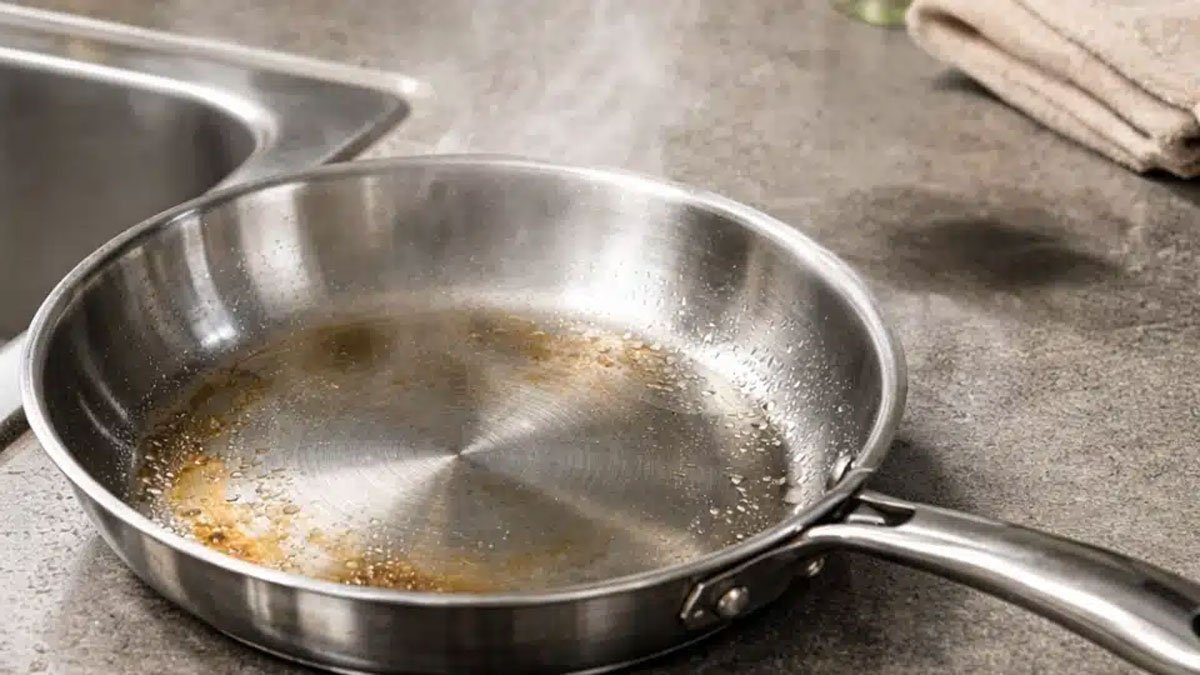
Bar Keepers Friend and a damp sponge remove most bottom-of-pan discoloration in under 5 minutes without scratching the metal. For baked-on grime accumulated over years of cooking, a 20-minute baking soda boil followed by a gentle scrub does the job. Either way, you need nothing more than three household staples and some elbow grease.
The brown, black, and rainbow marks on your pan bottoms are not rust or permanent damage. They are polymerized oil, mineral deposits from tap water, and heat-induced oxidation — layers that build up slowly with every meal you cook. A pan that looks ruined is almost always salvageable. What follows covers every method worth your time, from a 30-second wipe-down to a full restoration of decade-old cookware.
Why Pan Bottoms Get Discolored
The dark residue on a pan bottom is polymerized oil: fat molecules bonded to the metal surface under high heat, forming a thin brownish film chemically similar to the seasoning on cast iron. Each time oil drips down the side of a pan and hits a hot burner, another layer bakes on.
Blue and rainbow tints come from chromium oxide, a natural reaction when the chromium in stainless steel is heated past roughly 500 degrees Fahrenheit. The color is cosmetic only. The pan is structurally fine. White, chalky spots are mineral deposits left behind after water evaporates, especially common in homes with hard water. None of these conditions affect how the pan cooks, but they do make cookware look decades older than it is.
Tools and Materials You Need
Every effective method falls into one of three categories: mild abrasives, chemical cleaners, or heat-based approaches. The table below breaks down what each product costs, how aggressive it is, and which stain type it handles best.
| Product | Approx. Cost | Aggressiveness | Best For |
|---|---|---|---|
| Baking soda + white vinegar | $1.50 | Mild | Light discoloration, rainbow tint |
| Bar Keepers Friend (powder) | $7.43 (12 oz) | Medium | Brown stains, moderate buildup |
| Brillo Cameo | $6.82 (10 oz) | Medium-High | Stubborn black marks, oxidation |
| Easy-Off Heavy Duty oven cleaner | $7.02 (24 oz) | High | Years of grime, heavy restoration |
| 0000-grade steel wool | $6.14 (10-pack) | High | Deep scrubbing on brushed finishes only |
You also need a non-abrasive sponge or soft cloth, rubber gloves, and a well-ventilated workspace if using oven cleaner. Skip green Scotch-Brite pads. They contain aluminum oxide particles that leave micro-scratches on stainless steel and dull the finish permanently.
Step-by-Step Cleaning Methods
Start with the mildest method and work your way up. Jumping straight to steel wool when baking soda would have done the job is the fastest route from a cosmetic issue to a permanently scratched pan bottom.
Method 1: Baking Soda and Vinegar Paste
Time: 5 to 10 minutes. Best for: light brown stains and rainbow discoloration.
- Flip the pan upside down and sprinkle roughly 3 tablespoons of baking soda across the bottom of a 10-inch pan.
- Pour a small amount of white vinegar over the baking soda. The mixture will fizz immediately. Let it sit for 2 to 3 minutes.
- Scrub in circular motions with a damp sponge, using moderate pressure. The baking soda lifts polymerized oil without scratching.
- Rinse with warm water and dry immediately with a clean towel to prevent water spots.
Baking soda sits at roughly 2.5 on the Mohs hardness scale, well below stainless steel at 5.5 to 6.3. The crystals break down under pressure before they can scratch. The vinegar’s acidity dissolves mineral deposits, and the fizzing action helps lift debris from microscopic grooves in the metal.
Method 2: Bar Keepers Friend
Time: 3 to 5 minutes. Best for: brown stains and moderate polymerized oil buildup.
- Dampen the bottom of the pan with warm water.
- Sprinkle about a teaspoon of Bar Keepers Friend powder directly onto the wet surface.
- Rub with a damp sponge in small circles. A white paste forms and brown stains lift almost immediately.
- Rinse thoroughly and dry right away.
Bar Keepers Friend contains oxalic acid, which dissolves metal oxides chemically rather than just abrading them mechanically. That is why it works faster than baking soda on stubborn stains. Do not let the paste sit for more than 60 seconds, and keep it far away from non-stick coatings and anodized aluminum.
Method 3: Boiling Baking Soda

Time: 20 to 25 minutes. Best for: baked-on black residue and multi-layer buildup.
- Fill a large pot with enough water to submerge the bottom of the stained pan.
- Add a quarter-cup of baking soda per quart of water and bring to a boil.
- Carefully place the stained pan into the boiling solution and reduce heat to a gentle simmer.
- Let it sit for 15 to 20 minutes. Heat plus an alkaline solution loosens polymerized oil bonds at the molecular level.
- Remove the pan with tongs, let it cool slightly, then scrub with a soft sponge. The residue wipes away with minimal effort.
Wirecutter’s testing team found this method especially effective on pans where scrubbing alone had failed. Heat opens the microscopic pores in the metal, letting the alkaline solution penetrate underneath the oil layers.
Method 4: Easy-Off Oven Cleaner (Heavy Duty)
Time: 15 to 30 minutes. Best for: extreme cases, decade-old buildup, full restoration.
- Take the pan outside or to a well-ventilated area and put on rubber gloves. Oven cleaner contains sodium hydroxide, which is highly corrosive to skin.
- Spray a thin, even coat on the bottom of the pan only. Avoid overspray onto the cooking surface or handle.
- Let it sit for 5 to 15 minutes depending on severity. Check every 5 minutes and do not let it dry completely.
- Scrub gently with a sponge or soft brush. The grime should slide off in sheets.
- Rinse repeatedly with warm water until no residue remains. Wash the entire pan with dish soap before cooking with it again.
The Kitchn tested this method against four others and found Easy-Off delivered the most dramatic transformation on heavily stained pans, though the fumes and safety precautions make it a last-resort option. Never use oven cleaner on aluminum. The lye will pit and corrode the surface within minutes.
Method 5: What the Reddit Community Swears By
On r/CleaningTips, a post titled “Help! my stainless steel pan is ruined” drew nearly 5,000 upvotes and over 2,000 comments in February 2026. The community consensus was surprisingly consistent, and it was not oven cleaner.
“BKF and a Scrub Daddy. That’s it. That’s the whole secret. I spent $40 on specialty cleaners before someone on this sub told me to just use Bar Keepers Friend. Ten minutes later my All-Clad looked brand new. I was genuinely angry at how easy it was.”
— Reddit user, r/CleaningTips, February 2026 (4,906 upvotes, 2,194 comments)
Another thread on r/cookware surfaced a lesser-known fix: sprinkling cream of tartar on a damp sponge and scrubbing in tight circles. Cream of tartar is mildly acidic and acts as a fine-grit polishing agent. Several commenters reported it removed rainbow discoloration that Bar Keepers Friend had left untouched.
Common Mistakes to Avoid
Most permanent damage to stainless steel pans happens during cleaning, not cooking. Scratching the finish, warping the metal, and leaving corrosive residue are all avoidable errors that shorten a pan’s lifespan by years. Avoid these five common mistakes and your cookware will outlast you.
Skipping the rinse and dry. Cleaning product residue creates new stains that are harder to remove than the originals. Oxalic acid from Bar Keepers Friend, if not rinsed completely, leaves a chalky white film. Rinse with warm water and dry immediately with a microfiber towel.
Using the wrong scrubber. Standard steel wool and green scrub pads scratch stainless steel. If you must use steel wool, stick to 0000-grade and scrub in the direction of the grain lines. A Brillo pad from under the sink is far more abrasive than most people realize.
Mixing cleaning products. Baking soda and vinegar are safe together. But never combine Bar Keepers Friend with bleach or ammonia-based cleaners. The reaction releases toxic chloramine gas. Stick to one product per session.
Letting oven cleaner dry on the pan. Sodium hydroxide becomes harder to remove as it dries and can etch the metal if left for more than 20 minutes. Set a timer and check every 5 minutes. The moment the grime loosens, rinse it off.
Cleaning a hot pan. Cold water on a hot pan causes thermal shock, warping the bottom and ruining the cooking surface. A warped pan on a flat-top stove is functionally useless. Let the pan cool to room temperature first.
How to Prevent Future Buildup
A 30-second habit after each cooking session eliminates deep cleaning entirely. Before putting the pan away, wet a sponge, add a drop of dish soap, and wipe the bottom once. Oil that has not yet polymerized from repeated heating comes off with almost no effort.
Keep burner grates and drip pans clean. A surprising amount of gunk on pan bottoms is transferred from dirty burners, not from the pan itself. Wipe down gas burner grates weekly with a degreasing spray, and replace electric coil drip pans when they start to look crusted.
On gas stoves, keep the flame within the base of the pan. When flames lick up the sides, they superheat oil splatter and bake it onto the metal instantly. Match pan size to burner size. It saves cleanup time and uses less gas.
Frequently Asked Questions
Can baking soda scratch stainless steel pans?
No. Baking soda has a Mohs hardness of roughly 2.5, while stainless steel sits between 5.5 and 6.3. The soft crystals break down under pressure before they can scratch the metal surface. Steel wool, green scrub pads, and silica-based powdered cleansers are the real culprits behind scratched pans.
How often should I clean the bottom of my stainless steel pans?
A quick wipe after every use prevents most buildup. A deeper cleaning with Bar Keepers Friend every 2 to 3 months keeps bottoms looking close to new. Pans used daily on gas stoves may need monthly attention. Electric and induction users can go longer between deep cleans.
Is Bar Keepers Friend safe on all stainless steel pans?
Yes, for stainless steel only. It is safe on all grades including All-Clad, Made In, Cuisinart, and Tramontina. Do not use it on non-stick coatings, anodized aluminum, cast iron, or enameled surfaces. The oxalic acid will strip seasoning and etch reactive metals.
Can I use oven cleaner on the inside of my pan?
Technically yes for stainless steel interiors, but it is rarely necessary. The inside of a pan sees enough agitation from utensils and regular washing that buildup rarely reaches the severity found on the bottom. If you do use oven cleaner inside, wash the pan three times with hot soapy water before cooking with it.
Why do my pans have rainbow stains on the bottom?
Rainbow discoloration is chromium oxide, formed when stainless steel is heated above 500 degrees Fahrenheit. It is entirely harmless and cosmetic, the same phenomenon that creates colorful sheens on motorcycle exhaust pipes. Bar Keepers Friend or a vinegar soak removes it in under a minute.
Does hard water make pan stains worse?
Yes. Hard water deposits calcium and magnesium on pan bottoms after washing, creating a white chalky film that traps oil and makes future stains harder to remove. Dry pans immediately rather than air-drying, and consider a monthly vinegar wipe-down to dissolve mineral buildup before it accumulates.
A stainless steel pan with a clean bottom heats more evenly, slides smoothly across your stovetop, and signals that you take your kitchen seriously. Five minutes with a sponge and some powder beats 30 minutes of frustrated scrubbing six months from now. Pick the method that matches the severity, start gentle, and reach for the heavy artillery only when baking soda has genuinely failed.