

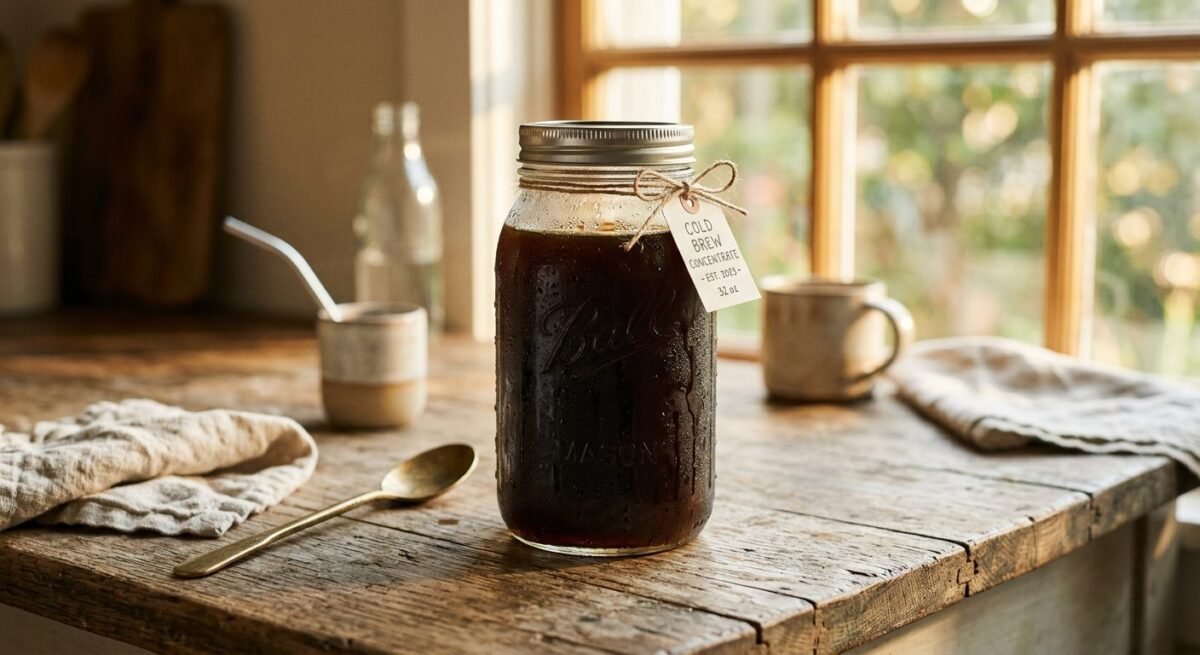
On a Sunday evening you pour hot coffee over ice, watch half the ice melt in under a minute, and end up with something half-warm and watery. That is iced coffee. Cold brew is the thing you actually wanted.
Making cold brew coffee at home takes about five minutes of hands-on work and yields a batch that lasts two weeks. The rest is just waiting.
What Cold Brew Actually Is (And Why It Tastes Different)
Cold brew is coffee steeped in cold water for 12 to 24 hours, with no heat involved at any stage. Because heat extracts the sharp acids and bitter compounds from coffee grounds, cold water extraction leaves them largely behind, producing coffee that is noticeably smoother and naturally sweeter without any added sugar.
According to research published in Scientific Reports (2018), cold brew coffee contains between 50% and 70% less titratable acid than hot-brewed coffee made from the same beans. That difference is not subtle when you taste them side by side.
Iced coffee and cold brew are not the same thing. Iced coffee is brewed hot and poured over ice, which dilutes it and rapidly degrades the flavor.
Cold brew is never exposed to heat, which is why it holds its flavor so cleanly. Coming back to the fridge the next morning to find a jar of inky, concentrated coffee feels a little more satisfying than it should.
What You Actually Need (The Short List)
A large jar or pitcher, coarse ground coffee, cold water, and something to strain through. That covers it. A dedicated cold brew maker is convenient but completely optional.

| What You Have | What to Use | Notes |
|---|---|---|
| Large jar or pitcher (32 oz+) | Mason jar, French press, or any container with a lid | Glass is ideal; plastic can absorb flavor over time |
| Straining device | Fine mesh strainer, coffee filter, cheesecloth, or French press plunger | Stack a paper filter inside a mesh strainer for cleaner results |
| Coffee | Coarse ground (like sea salt texture), medium-to-dark roast | Fine-ground coffee makes cold brew gritty and over-extracted |
| Water | Cold filtered water or tap water | Filtered water makes a cleaner-tasting final product |
The coffee grind size matters more than the brand. Coarse coffee grounds look and feel like rough sand, with distinct particles you can feel when you pinch them between your fingers.
Pre-ground grocery store coffee is almost always too fine for cold brew, which is why many first attempts turn out bitter and slightly murky.
A batch that makes four to six servings at home costs roughly $1.50 to $3 depending on the beans. A single cold brew at a cafe runs $5 to $7.
The math handles itself.
How to Make Cold Brew Coffee at Home: Step-by-Step
Combine 1 cup of coarse ground coffee with 4 cups of cold water in a large jar. Stir briefly, cover, and refrigerate for 12 to 24 hours. Strain out the grounds and store the concentrate in the fridge, diluting it 1:1 with water or milk when serving.
- Measure your coffee. Use 1 cup (about 90g) of coarse ground coffee for every 4 cups (about 950ml) of cold water. This produces concentrate.
- Combine and stir. Add the coffee grounds to your jar, pour in the cold water, and stir for about 30 seconds to make sure all the grounds are saturated. Dry pockets of coffee grounds at the top will not extract properly — this is the step most people skip.
- Cover and refrigerate. Place a lid or plastic wrap over the jar and put it in the fridge. Room temperature steeping works but produces a more bitter result; the fridge is the safer default.
- Wait 12 to 24 hours. Twelve hours gives a lighter, brighter flavor. Eighteen to twenty hours hits the sweet spot for most people. Beyond twenty-four hours, the flavor starts to go flat.
- Strain. Pour through a fine mesh strainer lined with a paper coffee filter into a clean jar. This takes a few minutes. Squeezing the filter to speed things up forces bitter compounds through.
- Store and serve. The concentrate keeps in the fridge for up to two weeks. To serve, dilute with water, milk, or oat milk at a 1:1 ratio over ice.
My first batch used fine pre-ground coffee because I assumed finer meant more flavor. The result tasted like very strong coffee-flavored water with a gritty sediment at the bottom.
Going back to coarse grounds fixed it completely.
The Cold Brew Ratio Guide — What Changes When You Adjust
The 1:4 ratio (coffee to water) produces concentrate, which you dilute before drinking. The 1:8 ratio gives you a ready-to-drink brew. Most people land somewhere between those two depending on how strong they want their cup.
| Ratio (Coffee:Water) | Result | How to Serve | Best For |
|---|---|---|---|
| 1:4 | Strong concentrate | Dilute 1:1 with water, milk, or oat milk | Lattes, mixed drinks, efficient storage |
| 1:6 | Balanced concentrate | Light dilution or serve straight over ice | All-around use, beginners |
| 1:8 | Ready-to-drink | Pour directly over ice | Black coffee drinkers, quick daily batches |
In practice, most people start with 1:8 because it seems safer and find it tastes thin after a day or two in the fridge. The 1:4 concentrate approach is more efficient — you store less liquid and mix it fresh each time, which keeps the flavor sharper.
Over-extracted cold brew (steeped too long at a strong ratio) goes past smooth into something almost syrupy, with a faint metallic edge at the back of the throat. Steep shorter or use a weaker ratio next time.
Why Your Cold Brew Is Not Working — and How to Fix It
Most cold brew problems trace back to three variables: grind size, ratio, and steep time. Bitter cold brew almost always means the grind is too fine; weak means not enough coffee; sour means it went too long.
| Problem | Likely Cause | Fix |
|---|---|---|
| Tastes bitter | Grind too fine, or steeped over 24 hours | Switch to coarser grind; keep steep time to 12-20 hours |
| Tastes weak or watery | Ratio too low, or steeped under 12 hours | Use more coffee (try 1:6 ratio) or extend steep time |
| Tastes sour or flat | Steeped over 24 hours, or stale coffee | Stick to 12-20 hours; use fresh-roasted beans |
| Gritty texture | Grounds passing through strainer | Double-strain with paper filter inside mesh strainer |
| Moldy (rare) | Steeped at room temperature too long, or dirty equipment | Always steep in fridge; sanitize jars before use |
The grind problem is the one that catches most people because pre-ground grocery coffee is labeled for drip machines, which use a medium grind, still too fine for cold brew.
If you do not have a grinder at home, many grocery stores and specialty shops will coarse-grind beans for you on request. A French press also works as a built-in strainer if you own one.
On r/Coffee, a community dedicated to all things coffee, the most common first-batch complaint is that the result is “too bitter and doesn’t taste smooth like the Starbucks version.” Nine times out of ten, switching to coarse grounds resolves it entirely (r/Coffee, various threads, 2024-2026).
How Long Cold Brew Lasts (and How to Store It Right)
Cold brew concentrate stored in an airtight glass jar lasts up to two weeks in the refrigerator. Ready-to-drink cold brew (already diluted) lasts seven to ten days.
Both should stay refrigerated after straining. Cold brew left at room temperature for more than two hours starts to taste off quickly.
| Type | Fridge Life | Freezer Option |
|---|---|---|
| Concentrate (1:4 ratio) | Up to 14 days | Freeze in ice cube tray; lasts 3 months |
| Ready-to-drink (1:8) | 7-10 days | Less practical; diluted flavor suffers when frozen |
Cold brew ice cubes are genuinely useful. Freeze leftover concentrate in an ice cube tray and drop them into your glass, you get cold brew that gets stronger as the cubes melt instead of weaker.
By the end of the glass the last few sips are the best ones.
When cold brew goes bad, you will know. It develops a faintly sour, almost fermented smell, quite different from the normal earthy coffee scent.
If it smells off, discard it and start fresh.
Frequently Asked Questions
Can you use any coffee for cold brew at home?
Any coffee works, but medium-to-dark roasts produce the best results because their flavor holds up through long cold steeping. Light roasts can taste thin or under-extracted in cold water. The most important requirement is a coarse grind, not the roast level.
What is the best coffee-to-water ratio for cold brew?
The most widely used ratio is 1:4 (1 cup coffee to 4 cups water) for a concentrate that you dilute before drinking. For ready-to-drink cold brew, use 1:8. Most beginners find 1:6 a useful starting point.
How long should you steep cold brew coffee?
Steep cold brew for 12 to 20 hours in the refrigerator. Twelve hours gives a lighter result; 18 to 20 hours is the sweet spot. Steeping beyond 24 hours tends to flatten the flavor rather than intensify it.
Do you need a cold brew maker or special equipment?
No special equipment is needed to make cold brew at home. A mason jar, a fine mesh strainer, and coarse ground coffee are enough to produce excellent results. Dedicated cold brew makers add convenience but do not improve the flavor.
Does cold brew have more caffeine than regular coffee?
Cold brew concentrate typically contains more caffeine per fluid ounce than drip coffee because of the higher coffee-to-water ratio used during brewing. Once diluted 1:1 for serving, a cup of cold brew delivers roughly 150-200mg of caffeine per 8 oz serving, comparable to standard drip coffee.
Can you speed up cold brew with warm water?
You can steep at room temperature (65-75 degrees F) for about 10-12 hours instead of 18-24 hours in the fridge. Hot water produces hot coffee, not cold brew, and changes the chemical extraction process entirely.
What exactly is cold brew concentrate?
Cold brew concentrate is cold brew made at a 1:4 coffee-to-water ratio, designed to be diluted before drinking. It stores efficiently and gives you control over final drink strength. Most bottled cold brew coffee products sold commercially are packaged as concentrates with dilution instructions on the label.
Ready to Skip the Cafe Queue
Cold brew coffee at home is not a recipe that requires technique, special equipment, or practice to get right. It is a waiting problem with a ratio, and once you understand that, everything else follows.
You combine coffee and cold water, put the jar in the fridge, and come back the next day. The hard part is remembering to start a batch before you run out.
If you are experimenting more with coffee at home, the First Watch iced coffee recipe covers the quick hot-to-cold approach for when you need something immediately. For dialing in grind and extraction, the James Hoffmann Chemex method is worth reading, the extraction principles carry directly into cold brew.
Make one batch. Adjust the ratio. By batch two you will wonder why you kept paying five dollars for the small cup.